Catering · November 4, 2026 · 5 min read
Catering Delivery Costs: Base Pay vs. Percentage Fees
Compare percentage-based catering delivery fees with agreed base pay. See an illustrative 20% savings example and how it could add up to $10,000 a year.
When a catering order gets larger, does your delivery bill need to grow at the same rate as the food subtotal? Not necessarily. A percentage-based fee can rise with the value of the meal even when the route and delivery tasks are similar.
Meeld's catering delivery approach is agreed base pay, not a percentage of the food order value. Restaurants can discuss the applicable delivery rate and service scope before committing to an order. The goal is simpler planning: understand the delivery cost, include it in your catering quote, and compare providers on the same work.
How percentage-based delivery fees work
Some providers calculate a fee as a percentage of the order value; others use a flat fee, a service-based quote, or a combination. Check the actual terms, including minimums and additional charges. There is no single pricing model used by every provider.
Under a purely hypothetical 10% fee, a $500 food order produces a $50 charge. A $1,000 food order produces a $100 charge. Those are examples of how percentage pricing works—not a claim about a named competitor's rates.
A more valuable order can also be physically larger or need more setup, so it is not automatically the same delivery job. The useful question is whether a higher charge reflects extra work or simply a higher food subtotal.
What Meeld means by base pay
Instead of calculating catering delivery pay as a share of your food sales, Meeld starts with an agreed base payment for the delivery service. Your restaurant can understand the applicable rate before placing orders under those terms.
This does not mean every order, route, or setup has one universal price. Confirm what is included and how changes are handled. Discuss the pickup and drop-off locations, order size, vehicle or equipment needs, receiving window, unloading, access, setup, time on site, additional stops, and any equipment returns.
Once the scope and terms are agreed, a more expensive menu should not be confused with a percentage-based delivery commission. If the physical delivery requirements change, ask for the applicable updated quote before confirming.
What could 20% savings—or $10,000 a year—look like?
Illustrative comparison, not a Meeld rate card or guaranteed result.
Assume a restaurant currently pays $50 for a particular delivery, equivalent to a hypothetical 10% charge on a $500 food order. Assume its agreed alternative price for the same service scope is $40. These figures are examples only.
- Current cost per delivery: $50.
- Illustrative alternative cost per delivery: $40.
- Difference: $10 per delivery.
- Reduction in delivery spend: $10 ÷ $50 = 20%.
- At 1,000 comparable deliveries per year: $10 × 1,000 = $10,000.
- Annual comparison: $50,000 versus $40,000 for those deliveries.
This shows how savings of up to 20%, or $10,000 a year at that volume, could arise under these assumptions. It is not a typical customer result, a guaranteed saving, or 20% off the food order. Your actual savings may be lower, zero, or negative depending on your current costs, agreed rates, volume, and service requirements.
Compare the complete delivery job—not just the headline price
A lower starting price is not a saving if your employees then need to drive to the venue, carry trays upstairs, or fix a missed setup. Compare quotes with the same requirements on both sides:
- Route and timing: the same addresses and pickup and receiving windows.
- Order size: enough vehicle space and appropriate insulated transport equipment.
- Venue access: parking, loading docks, security, elevators, and the actual handoff location.
- Setup: the exact agreed tasks, supplied equipment, and time needed on site.
- Changes and extras: waiting, additional stops, revised order details, cancellations, and equipment returns under the agreed terms.
- Coordination: delivery progress, receiving contacts, and support when an issue occurs.
Keep marketplace commissions, payment fees, and the delivery charge separate in your comparison. Changing a delivery partner does not automatically remove unrelated platform fees. Count staff-time savings separately unless you have measured them.
A simple way to estimate your restaurant's savings
- Review a representative set of recent catering deliveries, not only your largest food orders.
- Record the actual delivery charges and the service each charge included.
- Ask Meeld for terms covering those same delivery requirements.
- Compare the total applicable costs order by order.
- Use a realistic annual order volume, accounting for busy holiday periods and quieter weeks.
Annual delivery savings = comparable current annual delivery cost − comparable quoted annual delivery cost. Only apply the result to orders that would actually use the quoted service. If your routes and setup needs vary widely, compare each type of delivery separately rather than multiplying one unusually cheap example across the entire year.
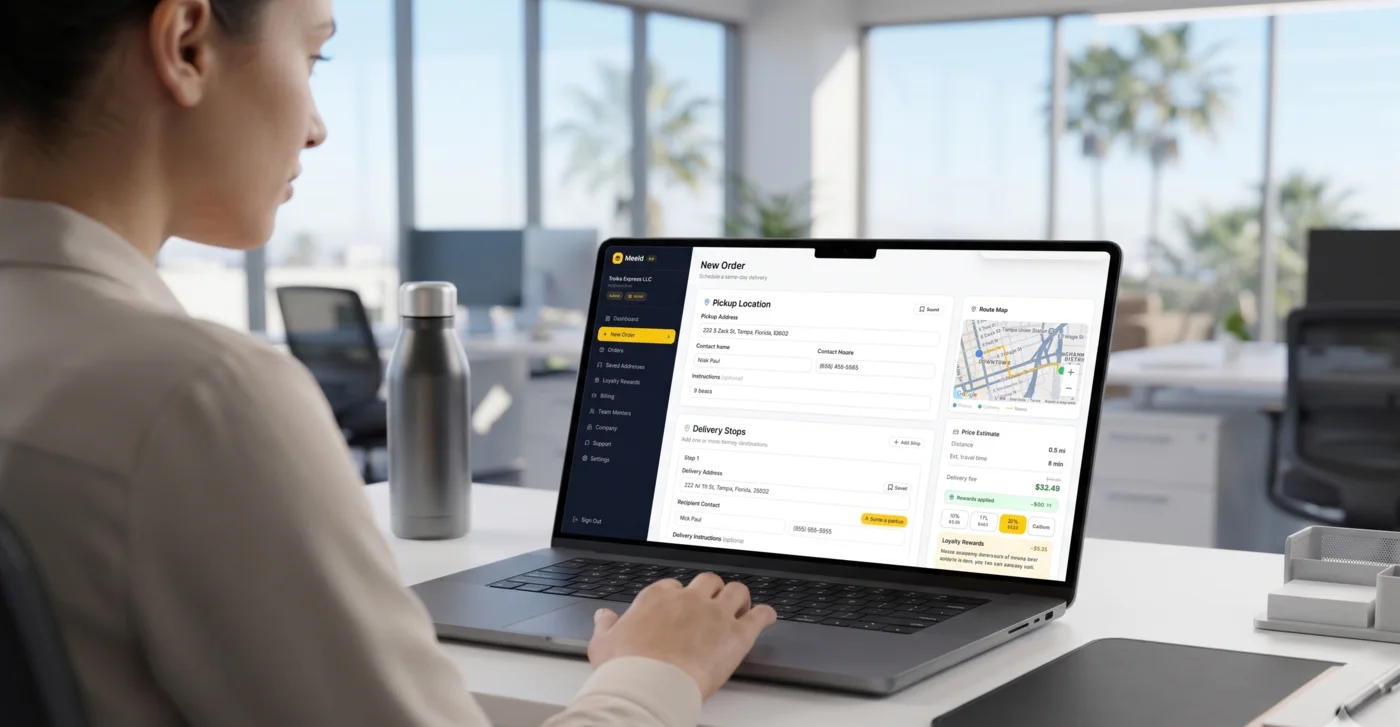
Predictable delivery costs matter during the holiday rush
When office parties and holiday events increase order volume, an unclear delivery charge makes it harder to quote customers and protect margins. Agreeing on base pay and the service requirements ahead of time gives the restaurant a more useful planning figure.
It also makes the conversation with a delivery partner more specific: what needs to move, when it must arrive, and what needs to happen at the venue. For an operational checklist, read how to prepare your restaurant for the holiday catering rush.
Compare your catering delivery costs with Meeld
Share your usual pickup locations, destinations, order sizes, delivery frequency, and setup requirements. Ask for applicable base-pay terms, what is included, and how additional work is priced. Coverage, availability, and final charges must be confirmed for your needs.
Request catering rates · Create a restaurant account · Explore catering delivery